Cross-Border Online Shopping in Europe: Customs, Duties and What Changed
VAT and customs duty are two different charges, and most first-time cross-border shoppers only know about one of them. VAT applies to nearly every online order now, folded into the checkout price on major platforms. Customs duty is separate — it only kicks in above a higher value threshold, and it’s the one that actually causes surprise bills at the door.
We get asked “why did I get charged extra at delivery” often enough that it’s worth separating the two clearly, because the fix for each is different.
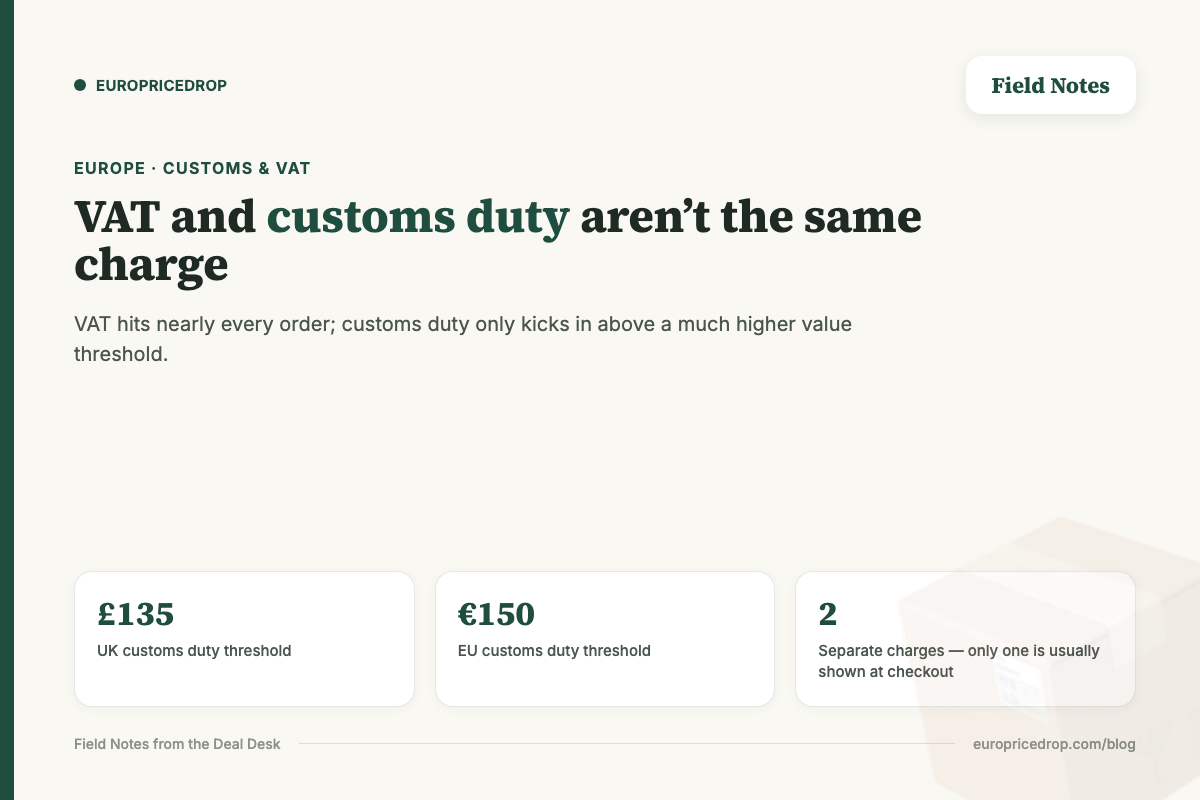
VAT vs. customs duty: not the same charge
VAT applies to almost every cross-border order and is usually included at checkout on major platforms. Customs duty is a separate charge that only applies above a higher value threshold — typically £135 in the UK or €150 in the EU — and is far less commonly included upfront.
VAT is a percentage tax on the sale, charged regardless of order value, and — as covered in our Europe online shopping guide — reputable platforms now include it at checkout so there’s no separate bill later. Customs duty is different: it’s an import tax that only applies once an order’s declared value crosses a threshold, and it’s charged on top of VAT, not instead of it.
| Charge | Applies to | Typically included at checkout? |
|---|---|---|
| VAT | Nearly all cross-border orders | Yes, on major platforms |
| Customs duty | Orders above £135 (UK) / €150 (EU) | Rarely — usually collected on delivery |
Why most shoppers never see a duty bill
The reason customs duty rarely comes up in practice: most individual orders on platforms like Temu, Shein and AliExpress sit well under the £135/€150 threshold. A single top or phone case doesn’t trigger it. Where it starts to matter is larger, higher-value orders — electronics, multiple items bundled into one shipment, or anything you’d genuinely describe as a big purchase rather than a routine one.
If you’re placing a high-value order specifically, it’s worth checking the platform’s own customs disclosure before paying — some display an estimated duty at checkout for orders that cross the threshold, others don’t calculate it until the parcel is already in transit, which is where the “surprise” bills tend to come from.
The UK and EU don’t share the same threshold
This trips up a fair number of shoppers who assume “customs rules” means one set of numbers across Europe. They don’t. The UK’s £135 threshold and the EU’s €150 threshold aren’t currency-converted versions of the same rule — they’re separately set, and post-Brexit UK-EU trade doesn’t get any special exemption either. A UK order arriving from an EU seller above €150-equivalent value can trigger EU-side duty rules on the way out and UK-side rules on the way in, depending on shipping direction.
Shopping cross-border today? We track which platforms fold VAT and duty into checkout cleanly.
See UK deals →How platforms handle this differently
This is where warehouse origin — the same factor that drives delivery speed, as we covered in our Temu Europe shipping times piece — matters for cost too, not just speed. Orders shipped from a regional EU or UK warehouse rarely trigger customs duty at all, since they’re not crossing the external border the same way a China-direct shipment does. AliExpress’s “Choice” badge and Temu’s expanding regional stock both reduce customs exposure as a side effect of being closer to you already, not just a faster-delivery feature.
Amazon sidesteps most of this entirely for orders fulfilled from its own EU or UK warehouses, which is part of why it remains the lowest-friction option when duty exposure is a real concern rather than an afterthought — you’re rarely buying from outside the customs zone in the first place.
How to avoid a surprise bill
- Check the declared value before confirming a large order. If a bundle is creeping past £135/€150, consider splitting it into two smaller orders instead — legitimate, and it keeps each one under the duty threshold.
- Favour EU/UK-warehouse listings for bigger purchases. They’re far less likely to trigger duty at all, on top of shipping faster.
- Read the checkout page for a duty estimate, not just the VAT line — some platforms show both, some only show VAT and leave duty for delivery.
- Keep the confirmation email. If a courier does request payment on delivery, the order confirmation showing what VAT was already charged helps resolve disputes quickly if something looks double-charged.
FAQ
What’s the customs duty threshold for online orders in the UK? £135 in declared order value. Below that, only VAT applies (usually already included at checkout). Above it, customs duty can apply on top.
What’s the threshold in the EU? €150. Like the UK, VAT applies regardless of value, but customs duty is a separate charge that only kicks in above this line.
Does buying from a Choice-badge AliExpress listing avoid customs duty? Often, yes — EU-warehouse listings aren’t crossing the external customs border the same way a China-direct shipment is, which significantly reduces the chance of a duty charge regardless of order value.
Can I get charged both VAT and customs duty on the same order? Yes, if the order crosses the value threshold — VAT applies almost universally, and duty applies on top for higher-value cross-border orders specifically.
We track which platforms and warehouse routes minimise cross-border cost, not just delivery time — check our UK Temu page for the current tracked deal.