How Europeans Shop Online: Country-by-Country Habits
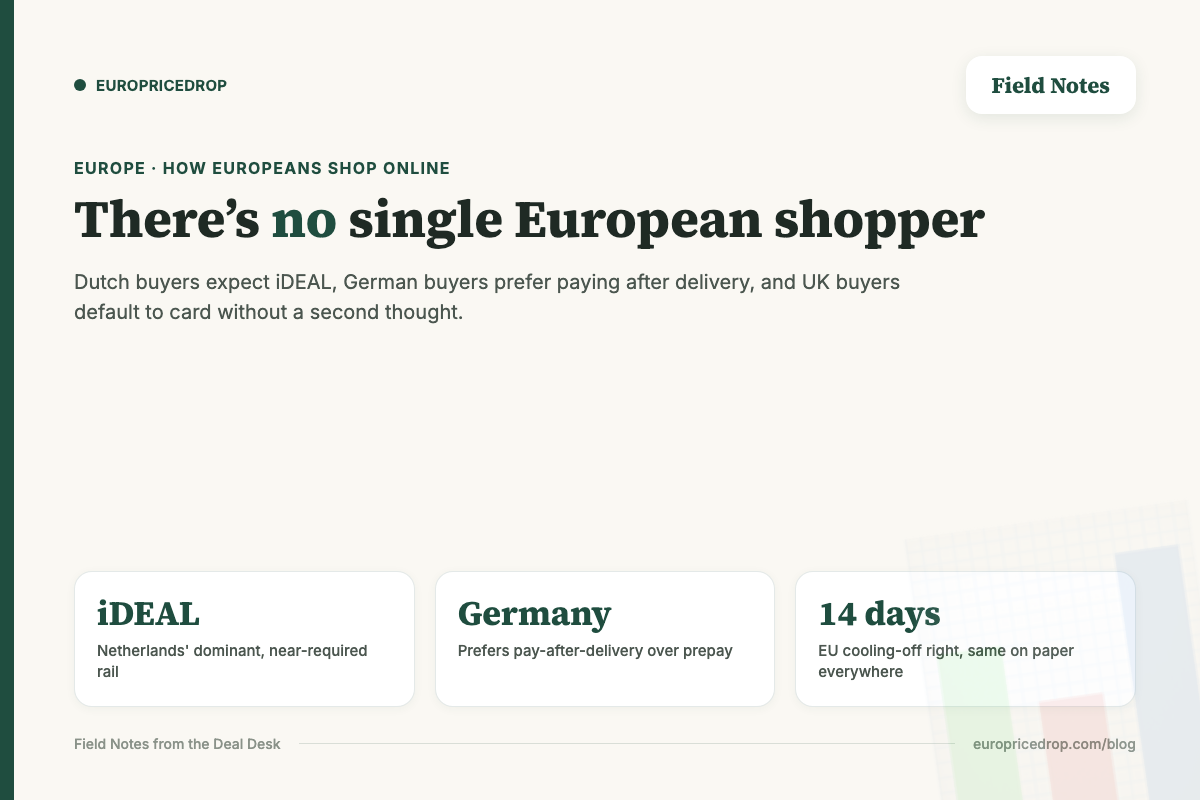
There’s no single “European shopper.” A Dutch buyer expects iDEAL at checkout and will bail if it’s missing. A German buyer often wants to pay after delivery, not before. A UK buyer defaults to card and rarely questions it. These aren’t small quirks — they shape which platforms actually convert in each market.
We track checkout behaviour across the markets we cover because it directly affects which codes and offers are worth surfacing where. Here’s what the pattern actually looks like, country by country.
Payment habits are the clearest divide
The UK and Ireland lean hardest on cards. Germany and the Netherlands lean on bank-linked methods (SEPA, iDEAL, Klarna) more than cards. Southern Europe (Spain, Italy) sits in between, with app-based transfer methods like Bizum growing fast in Spain specifically.
| Country | Dominant payment method | Card usage |
|---|---|---|
| UK | Card, Apple Pay, PayPal | High |
| Germany | SEPA, Klarna, Giropay | Lower — bank-linked preferred |
| Netherlands | iDEAL | Very low card share |
| Spain | Bizum, SEPA | Mixed, app transfer rising fast |
| France | Carte Bleue, SEPA | High but bank-specific |
The Netherlands is the standout case — iDEAL isn’t a nice-to-have there, it’s close to a requirement. A checkout without it will lose a meaningful share of Dutch buyers before they even reach the card step, because they don’t expect to need one.
Germany buys differently than its neighbours
German shoppers show a documented preference for “buy now, pay after delivery” options — Klarna’s invoice model exists largely because of this expectation. It’s tied to a broader trust pattern: German consumers tend to want to see and confirm the product before money changes hands, more so than shoppers in the UK or France. Platforms that only offer prepay checkout tend to see softer conversion in Germany specifically for that reason.
Mobile is the default everywhere, but not equally
Mobile commerce dominates across every market we track, but the gap between mobile and desktop varies. Southern European markets (Spain, Italy) skew more mobile-heavy relative to desktop than Germany or the UK, where a meaningful slice of shoppers still finish higher-value purchases on desktop — a pattern that tracks with how each market uses phones for browsing versus checkout specifically, rather than any difference in how widely smartphones are actually owned.
Shopping from a specific country? We track local payment methods and checkout quirks per market.
See UK deals →Trust signals matter more in some markets than others
French and German shoppers tend to weight return policy and seller reputation more heavily before completing a purchase than UK shoppers do, based on the checkout drop-off patterns we’ve seen across our tracked pages. That’s part of why platforms like Amazon — with a strong, consistent return process — convert well in those markets even without leading on price. UK shoppers, by contrast, tend to move faster from browsing to checkout once the price looks right, with less research friction along the way.
This connects to a broader point covered in our Europe online shopping guide: the EU’s 14-day cooling-off right is the same on paper across member states, but how visibly and clearly a platform surfaces that right at checkout genuinely affects whether cautious shoppers complete the purchase.
What this means for where deals actually land
Because checkout behaviour differs this much by country, a promo code or discount that converts well in the UK doesn’t automatically perform the same in Germany or Spain — it’s not just about the discount size, it’s about whether the checkout flow around it matches what that market expects. This is the whole reason we run country-specific pages rather than one generic European listing per brand: a Temu UK page and a Temu Germany page aren’t just translated, they’re tracking genuinely different shopping contexts.
Our best shopping websites breakdown covers which platforms lean into which of these regional strengths — Amazon’s trust-and-reliability model plays especially well in the markets that weight return policy heavily, for instance.
FAQ
Why do German checkouts ask for IBAN instead of a card? German shoppers show a strong preference for SEPA direct debit and invoice-based payment (pay after delivery) over prepaid card checkout — it’s a trust pattern, not a technical limitation.
Is mobile shopping bigger in Europe than desktop? Yes, across nearly every market, though the margin varies — Southern Europe skews more heavily mobile than Germany or the UK, where desktop still holds a meaningful share for larger purchases.
Do UK and EU shoppers have the same return rights? Broadly similar — both offer a 14-day cooling-off period on most online purchases — but the frameworks are legally separate post-Brexit, and enforcement conventions can differ by retailer.
Why does iDEAL matter so much for Dutch shoppers specifically? It’s the dominant payment rail in the Netherlands by a wide margin. A checkout without it isn’t just less convenient for Dutch buyers — many will assume the site isn’t set up for their market at all.
We track these checkout patterns per country because they shape which deals actually convert — see our UK Temu page for what’s live in the market with the highest card-payment share of the ones we track.