Shein Market Share in Europe: How Big Is It, Really?
Shein has become one of the largest fast-fashion e-commerce players in Europe within a relatively short window, built on a daily-catalogue-turnover model that traditional fashion retailers can’t match on speed. It’s also become one of the most scrutinised platforms in Europe, facing packaging waste, product safety, and marketplace-conduct investigations that are starting to test whether the growth model holds up under regulatory pressure.
We track Shein pricing and deals across every market we cover, which gives us a reasonable vantage point on where its actual strength sits — and where the competition is closer than the headlines suggest.
Where Shein is strongest
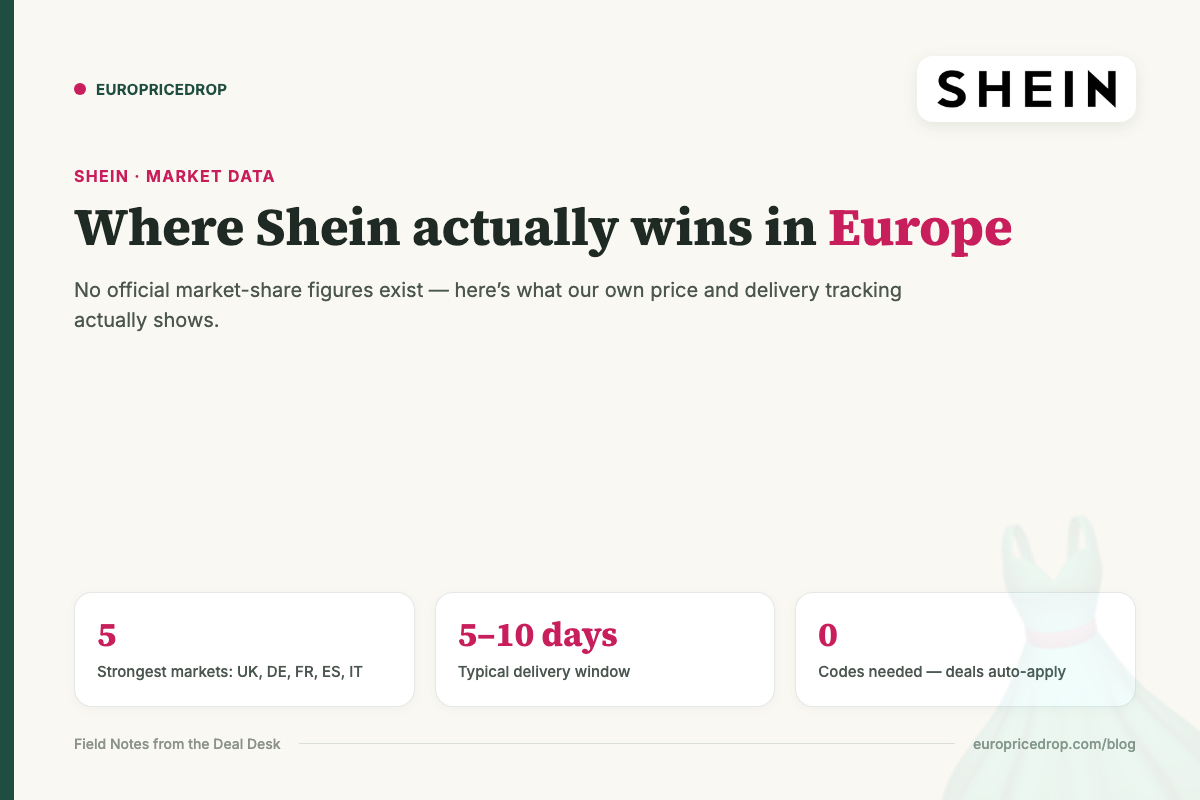
Shein's strongest European footholds are the UK, Germany, France, Spain and Italy — its largest fast-fashion markets by order volume among the countries we track. Growth has been fastest in markets with younger demographics and high social-commerce engagement.
Shein’s model — no promo code to hunt for, discounts auto-applied at checkout, catalogue refreshed daily — maps particularly well onto impulse-driven, social-media-sourced fashion discovery. That’s part of why its strongest growth skews toward markets and demographics with the heaviest short-form video usage, which tracks with the broader social commerce shift covered in our European consumer shopping trends piece.
The competitive picture isn’t as one-sided as it looks
Shein competes directly with Zalando across most of the EU markets we track, and with country-specific fashion retailers — Primark and ASOS in the UK, Zalando and About You in Germany, Zara and Mango in Spain. None of these compete on Shein’s catalogue turnover speed, but several compete harder than expected on price for comparable categories, and all of them win decisively on return-process trust, which matters more for fashion than almost any other category given how return-heavy clothing purchases are.
Temu has also become a genuine competitor for Shein specifically in fashion basics, despite Temu’s broader positioning as a general marketplace rather than a fashion specialist. Our Temu vs AliExpress comparison covers Temu’s model in more depth, though the more relevant comparison for fashion specifically is Temu vs Shein rather than Temu vs AliExpress.
Comparing Shein against the competition? We track live deals across the UK and beyond.
See Shein UK deals →Regulatory pressure is the real wildcard
Shein has faced EU-level scrutiny on several fronts: packaging and parcel-volume environmental impact (the sheer number of small, individually-shipped parcels the model generates), product safety compliance checks on marketplace third-party listings, and general marketplace-conduct rules that are tightening across the EU regardless of platform. None of this has meaningfully slowed order volume yet, but it’s the clearest structural risk to the current growth trajectory — more so than direct competition from any single rival platform.
The EU’s closure of the low-value import exemption already reshaped Shein’s cost structure once (see our European e-commerce statistics piece for how that shift played out across platforms generally) — further tightening on parcel-level environmental fees is a live possibility being discussed at the EU level, not a confirmed policy yet.
A note on what “market share” actually means here
Shein is a private company and doesn’t publish detailed country-level sales figures, so precise market-share percentages you’ll see cited elsewhere should be read as estimates from third-party analysts, not official disclosures. What we can speak to directly is order-volume and pricing behaviour on the pages we track — which markets show the deepest promo activity, fastest delivery, and strongest repeat-purchase signals. That’s a narrower claim than “market share,” and a more honest one, given how opaque the underlying company data actually is.
Delivery speed: competitive, not class-leading
Shein typically delivers in 5–10 business days across the markets we track — faster than AliExpress’s standard shipping, slower than Amazon, roughly in line with Temu. It’s not winning on logistics; it’s winning on catalogue breadth and price at that delivery speed, which is a different kind of competitive edge than same-day or next-day delivery would be.
What this means for shoppers, not just market-share tracking
Practically, none of this changes what Shein is good for right now: fast-turnover fashion at low price points, with auto-applied deals rather than codes to chase. The regulatory story is worth watching if you care about the platform’s longer-term trajectory, but it hasn’t changed pricing or delivery experience for shoppers as of now. Check our Shein Europe hub for the current tracked deal and free-shipping threshold in your market.
FAQ
Is Shein bigger than Zalando in Europe? It depends on the market and how you measure it — Shein leads on order volume and catalogue speed in most markets we track, while Zalando retains stronger trust and return-process reputation. They’re not directly comparable on a single “bigger” metric.
Why is Shein facing regulatory scrutiny in the EU? Primarily around packaging and environmental impact from high parcel volume, product safety compliance on third-party marketplace listings, and general marketplace-conduct rules being tightened EU-wide.
Does Shein use promo codes like Temu does? No — Shein’s model runs on auto-applied flash-sale pricing rather than codes to hunt for and enter at checkout.
Which countries is Shein strongest in across Europe? The UK, Germany, France, Spain and Italy show the deepest order volume among the markets we track, broadly tracking with social-commerce engagement and younger-skewing demographics in those markets.
We track Shein pricing across every market — check our UK Shein page for the current tracked deal and free-shipping threshold.