Top European Online Marketplaces (And the Local Players Worth Knowing)
The global marketplaces — Amazon, Temu, AliExpress — get most of the attention, but they don’t dominate everywhere. Poland runs on Allegro. The Netherlands runs on Bol.com. France has Cdiscount and Fnac alongside Amazon. Knowing the local player matters if you’re actually price-checking rather than just defaulting to whichever site loads first.
We track local competitors alongside the global platforms for every country we cover, because the “best deal” question genuinely depends on which marketplace has the strongest foothold where you’re shopping.
The global players
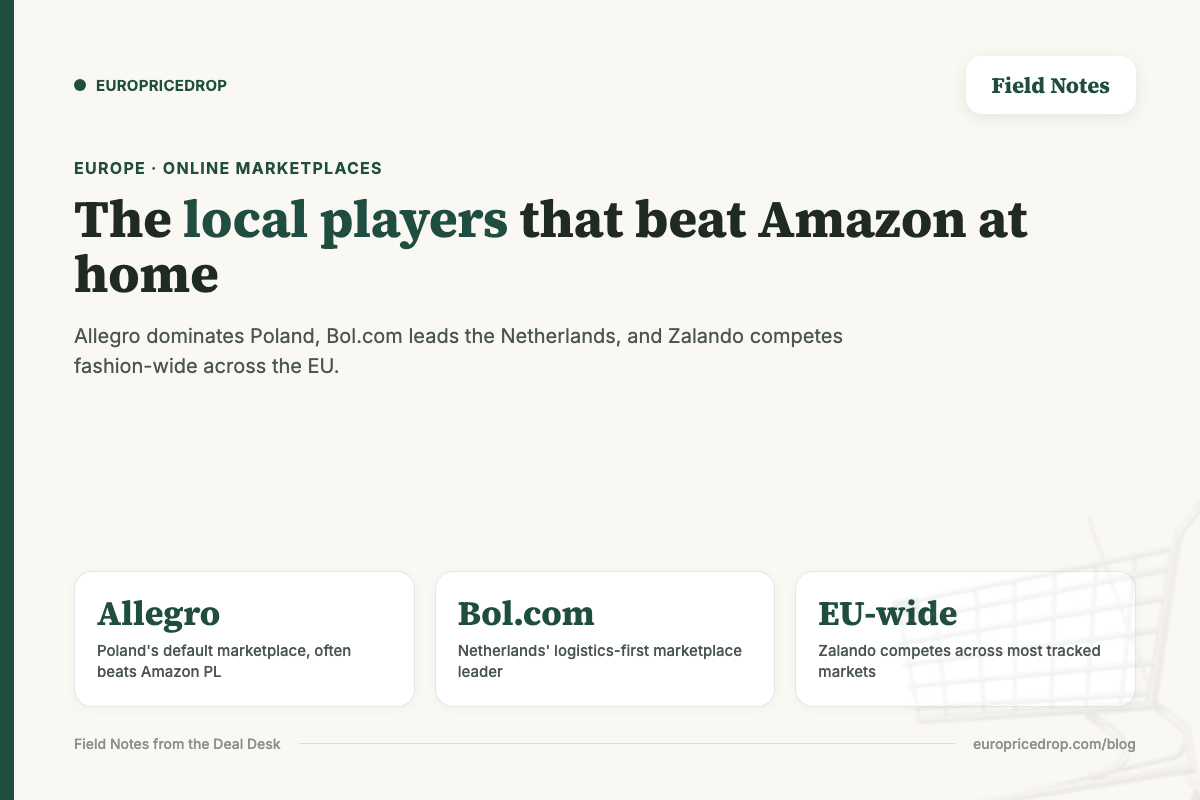
Amazon, Temu and AliExpress operate across nearly every European market. Regional marketplaces — Allegro (Poland), Bol.com (Netherlands), Cdiscount (France), Zalando (fashion, pan-EU) — often beat them on price or selection in their home country specifically.
Amazon is the closest thing to a universal default — present in every major market, fastest delivery, most consistent return process. Temu and AliExpress run the same factory-direct model everywhere, with pricing that stays fairly consistent across borders. Both are covered in depth in our best shopping websites in Europe breakdown.
The regional marketplaces worth knowing
| Country | Local marketplace | What it’s known for |
|---|---|---|
| Poland | Allegro | The default marketplace — often beats Amazon PL on selection and price |
| Netherlands | Bol.com | Local logistics edge, strong on electronics and books |
| France | Cdiscount | Aggressive pricing on electronics and appliances |
| Germany | MediaMarkt / Otto.de | Electronics (MediaMarkt), general goods (Otto) |
| Switzerland | Digitec Galaxus | Dominant for electronics, Swiss-based logistics |
| Norway | Elkjøp / Komplett | Electronics specialists with strong local trust |
| Sweden | CDON / Elgiganten | General marketplace (CDON), electronics (Elgiganten) |
| Ireland | Argos IE / Currys IE | UK-adjacent retail chains with strong Irish presence |
Allegro deserves specific mention — it’s not a secondary option in Poland, it’s the primary one. Amazon entered the Polish market relatively late and still competes from behind Allegro’s established seller network and logistics footprint. If you’re shopping Poland specifically and only checking Amazon, you’re very likely missing the better price.
Zalando runs differently again — it’s pan-European rather than single-country, and it’s fashion-specific rather than general marketplace. It shows up as a genuine price comparison point across most of the EU markets we track, from Germany to Croatia to Portugal, which makes it one of the few regional players actually worth checking regardless of which country you’re shopping from.
Comparing marketplaces for your country? We track local competitor pricing alongside the global platforms.
See AliExpress UK deals →Why the local marketplace sometimes wins
Regional marketplaces have two structural advantages global platforms can’t always match: local logistics networks built specifically for that country’s geography (Bol.com’s Dutch warehouse network, for instance, is hard to beat inside the Netherlands), and payment method integration that matches local habits — see our how Europeans shop online piece for why that matters more than it sounds like it should.
The trade-off is usually catalogue breadth. Allegro and Bol.com are strong within their category focus but don’t match Amazon’s sheer product range, and they don’t operate meaningfully outside their home country the way the global platforms do.
Seller trust works differently on regional marketplaces
Global platforms standardise buyer protection across every seller on the platform, which is part of why Amazon’s return process feels the same whether you’re buying from a UK seller or an international one. Regional marketplaces vary more — Allegro and Bol.com both run their own seller-verification systems, generally well-trusted within their home country, but less familiar (and less easy to research) if you’re shopping from outside that market. This is less of a concern buying domestically and more worth a second look if you’re ordering across a border into a regional marketplace you don’t normally use.
How to actually compare
If you’re shopping from a country with a strong regional marketplace, the smart move is checking both before committing — the global platform for range and consistency, the local one for price and delivery speed on categories it specialises in. Our Europe online shopping guide covers the VAT and payment basics that apply regardless of which marketplace you land on.
FAQ
Is Allegro cheaper than Amazon in Poland? Often, yes — particularly on electronics and home goods where Allegro’s seller network has deeper local inventory. It’s worth checking both before buying anything above a small ticket size.
What is Bol.com and why does it matter in the Netherlands? It’s the Netherlands’ largest domestic online marketplace, with a logistics network built specifically for Dutch delivery — it frequently beats Amazon NL on delivery speed for that reason.
Is Zalando worth checking outside Germany? Yes — it operates across most of the EU markets we track, not just Germany, and is genuinely competitive on fashion pricing in most of them.
Do regional marketplaces accept the same payment methods as global platforms? Usually better-matched to local preference, not worse — that’s part of their advantage. Bol.com leans into iDEAL, Allegro into Polish bank transfer options, in ways that feel native rather than bolted on.
We track both global and regional pricing across every market — check our UK AliExpress page for the current tracked deal if you’re comparing against a local marketplace.