Is Amazon Legit and Safe to Use in Portugal?
Yes — Amazon is legitimate and safe to use from Portugal. There’s no dedicated Amazon.pt storefront, so most Portuguese shoppers order through Amazon.es or Amazon.de, both of which are EU-regulated retailers with the same return windows, buyer guarantees, and seller-vetting rules that apply across the bloc. The real work is knowing which seller you’re buying from and what protections follow the order, not whether Amazon itself is trustworthy.
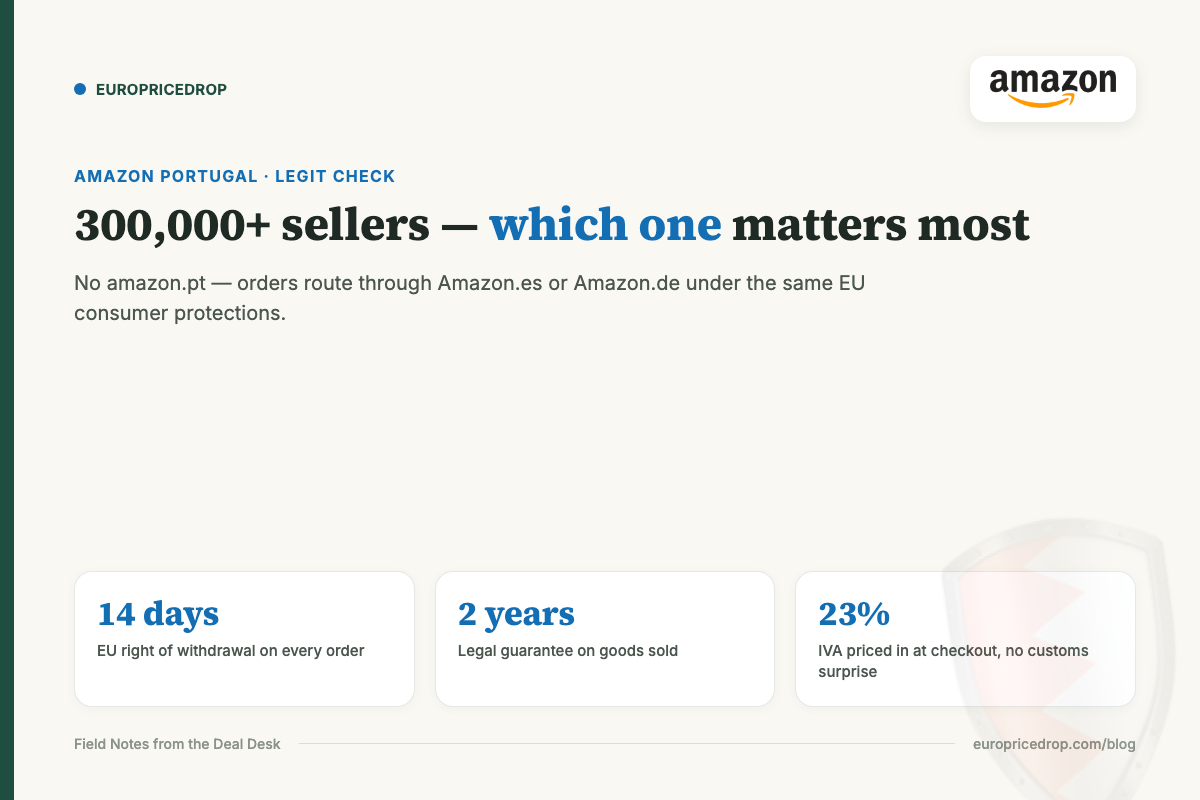
Amazon is a real, EU-regulated marketplace — the legitimacy question in Portugal isn't about Amazon the company, it's about which of its 300,000+ third-party sellers is fulfilling your specific order. First-party ("Ships from and sold by Amazon") and Prime-badged listings carry the strongest guarantees; third-party sellers vary more, and that's where a few minutes of checking pays off.
Why the “is it legit” question even comes up
Portugal doesn’t have its own Amazon.pt domain, unlike the UK, Germany, France, Italy, and Spain, which each run a localized storefront. Portuguese shoppers typically order through Amazon.es (Spain) for faster cross-border shipping, or Amazon.de and Amazon.co.uk for wider selection. That cross-border setup is normal — Amazon runs the same way for buyers in Ireland, Austria, and a handful of other EU markets without a local domain — but it’s also exactly the kind of setup that makes people ask whether the checkout they’re looking at is really Amazon or something dressed up to look like it.
The short version: if you’re on amazon.es, amazon.de, or amazon.co.uk directly (not a link from an unsolicited email or a third-party ad), you’re on Amazon’s real infrastructure. The platform itself isn’t the risk. What varies order to order is the marketplace seller behind a given listing, and Portugal’s buyers face the same seller-quality spread that every EU market does.
What EU consumer law actually guarantees you
Because Portugal is in the EU, every Amazon order — regardless of which country-domain you buy from — falls under the same baseline consumer protection rules:
- 14-day right of withdrawal. You can return most items within 14 days of delivery for any reason, no justification required, under EU Directive 2011/83/EU.
- 2-year legal guarantee. Goods must match their description and work as expected for at least two years from delivery; defects within that window are the seller’s responsibility to fix, replace, or refund.
- 23% IVA is priced in at checkout. Portugal’s standard VAT rate applies to the order total before you confirm — there’s no surprise customs bill on an intra-EU Amazon order the way there can be on a shipment from outside the EU.
- A-to-z Guarantee. Amazon’s own buyer-protection program covers third-party marketplace orders that arrive late, damaged, or not as described, on top of the statutory EU rights above.
None of this is Amazon-specific generosity — it’s the legal floor every EU-facing retailer has to meet. What Amazon adds on top is dispute mediation through the A-to-z Guarantee, which saves you from having to chase an individual seller directly if something goes sideways.
Checking a listing before you buy
The fastest legitimacy check on any Amazon listing takes under a minute:
| Signal | What it tells you |
|---|---|
| ”Ships from and sold by Amazon” | Amazon handles fulfillment and returns directly — the strongest guarantee tier |
| Prime badge | Amazon-vetted logistics; usually faster, more reliable delivery to Portugal |
| Seller rating below ~90% or under ~50 ratings | Higher variance — read the last 10–20 reviews before ordering |
| Price far below every other listing for the same item | Common scam pattern; cross-check the seller’s other listings and rating history |
| ”Fulfilled by Amazon” (FBA) but third-party seller | Amazon handles shipping and returns even though a third party owns the listing — still solid |
Third-party sellers aren’t inherently a problem — plenty run legitimate small businesses through Amazon’s marketplace — but they’re the variable in the equation. A seller with a short track record and no FBA badge is worth a second look before you commit to a larger purchase; a well-established seller with thousands of ratings is functionally as safe as buying from Amazon directly.
What actually goes wrong (and how rare it is)
The most common Portugal-relevant complaint isn’t fraud — it’s a mismatch between the listing’s stated origin and where the item is actually shipping from, which affects delivery time more than legitimacy. An item marked as shipping from a Spanish or German warehouse should land within the timeframe Amazon quotes at checkout; if a tracking number sits unchanged for days past that window, that’s the point to contact the seller through Amazon’s messaging system (never an email address supplied outside the platform) or open an A-to-z claim if the seller doesn’t respond within their required window.
Genuine counterfeit or non-delivery fraud on Amazon is uncommon relative to order volume, precisely because the A-to-z Guarantee exists as a backstop and because Amazon suspends sellers who accumulate enough valid complaints. That structural incentive is the actual reason Amazon reads as safe across every EU market it serves, Portugal included — not because every seller is equally careful, but because the platform has a real mechanism for making bad ones disappear.
Shopping Amazon from Portugal? Check current deals and Subscribe & Save offers before you check out.
See Amazon Portugal deals →How Amazon compares to Portugal’s other options
Portuguese shoppers comparing Amazon against local chains like Worten or FNAC PT are usually weighing selection and price against the comfort of a Portuguese storefront and Portuguese-language support — Amazon doesn’t localize checkout copy for Portugal specifically, even though the buyer protections are identical. For lower-priced factory-direct goods, AliExpress and Shein run a different model entirely (longer shipping windows, no Prime-style guarantee tier), which is a fair trade-off for price on non-urgent purchases but not a like-for-like substitute for Amazon’s faster logistics and stronger seller accountability. We break down how that price gap actually plays out across markets in our look at Temu and AliExpress pricing versus local retailers — the same VAT-and-shipping math applies whichever cross-border platform you’re comparing against a Portuguese chain.
FAQ
Does Amazon ship directly to Portugal? Yes. There’s no dedicated Amazon.pt site, so most orders route through Amazon.es or Amazon.de, both of which ship to Portuguese addresses under the same EU consumer protections as any domestic order.
Is there a real Amazon promo code for Portugal? Amazon runs rotating Lightning Deals and Subscribe & Save discounts rather than a single sitewide code — check our Amazon Portugal page for what’s currently live; deals apply automatically at checkout, no code entry needed.
What happens if a seller doesn’t deliver my order? File an A-to-z Guarantee claim through Amazon if the seller hasn’t resolved it within their response window. Amazon typically refunds the order and separately investigates the seller — you’re not left negotiating directly with a non-responsive third party.
Is it safer to buy “Ships from and sold by Amazon” listings? Generally yes — that label means Amazon handles fulfillment, customer service, and returns directly rather than a marketplace seller, which removes most of the variance that trips people up on third-party listings.
Want the wider picture? See how Amazon and the other big platforms stack up market by market across Europe.
Compare Amazon across Europe →