Europe Shopping Statistics by Country: VAT, Carriers and Local Competitors
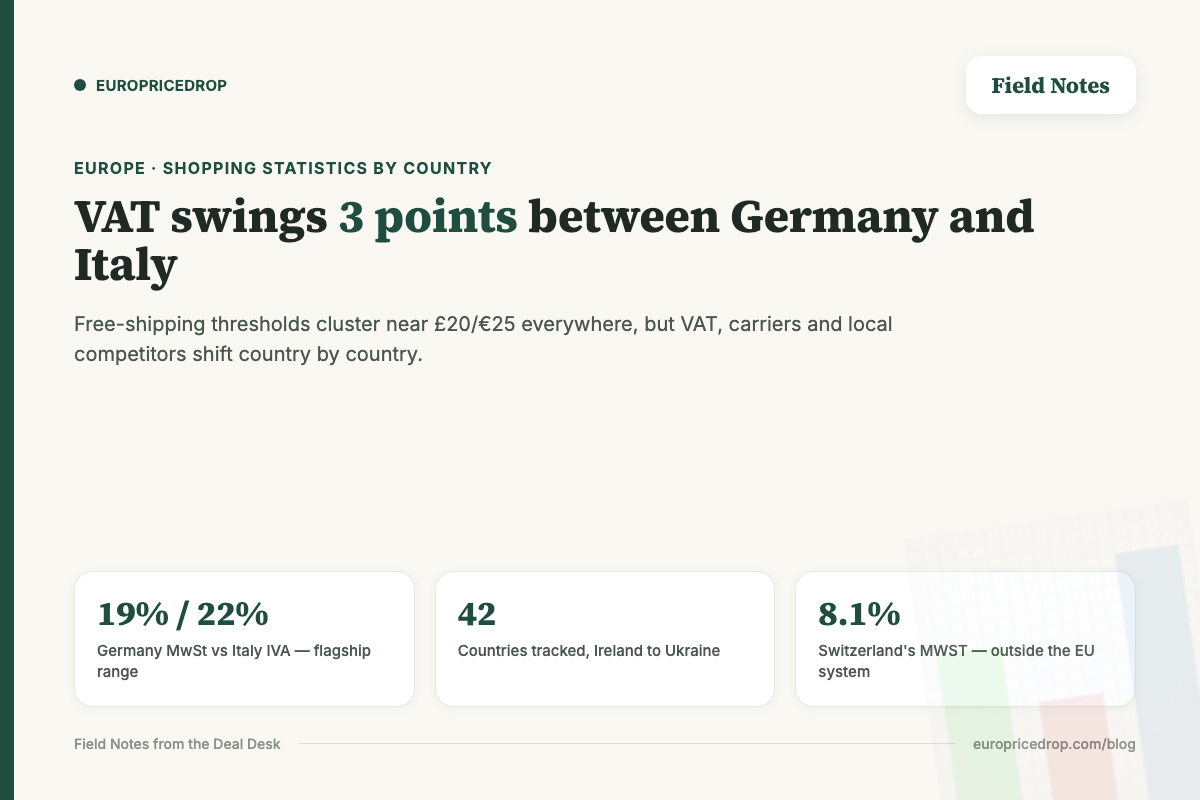
VAT rates alone swing three full percentage points between Germany (19%) and Italy (22%). Payment preference swings even harder — from the UK’s card-first checkout to the Netherlands’ near-total reliance on iDEAL. Neither shows up if you only look at Europe-wide averages, which is why we track pricing and shipping data per country rather than treating “Europe” as one market.
Here’s the country-level breakdown for the markets we track most closely.
The flagship markets, side by side
VAT ranges from 19% (Germany) to 22% (Italy) across the markets we track most closely. Free-shipping thresholds cluster around £20–€25 for factory-direct platforms, but the local competitor each brand is actually up against changes completely by country.
| Country | VAT | Local competitor to check | Main carriers |
|---|---|---|---|
| UK | 20% VAT | Argos, John Lewis, ASOS | Royal Mail, DPD, Evri |
| Germany | 19% MwSt | MediaMarkt, Zalando, Otto.de | DHL, DPD, Hermes |
| Spain | 21% IVA | El Corte Inglés, Zara, Mango | Correos, MRW, SEUR |
| France | 20% TVA | Fnac, Cdiscount, La Redoute | La Poste, Colissimo, DPD |
| Italy | 22% IVA | Mediaworld, Unieuro, Zalando IT | Poste Italiane, SDA, DHL |
| Netherlands | 21% BTW | Bol.com, Coolblue, HEMA | PostNL, DHL, DPD |
Italy carries the highest VAT of the flagship six, which is worth knowing if you’re price-comparing a purchase across borders — the same pre-VAT price lands noticeably higher once Italian VAT applies versus German.
Beyond the flagship six
Coverage extends well past these six markets — we track 42 countries in total, from Ireland and Austria to Poland, Georgia, and Ukraine. The pattern holds everywhere: VAT names change (BTW in the Netherlands, MwSt in Germany, IVA in Spain and Italy), local competitor sets change, and payment preference changes, even where the underlying platform and code stay consistent.
None of that is cosmetic. A platform that only localises the language on its checkout page — without adjusting for the actual VAT label, payment rail, or competitor context shoppers expect — tends to convert worse in that market regardless of how competitive the underlying price actually is.
Poland is a useful example of how different the picture gets outside Western Europe — Allegro, not Amazon, is the marketplace shoppers default to first, and our top European marketplaces piece covers why that local-platform dynamic matters more in some countries than others.
Check the numbers for your country. We track VAT, carriers and local competitors for every market.
See UK deals →Free-shipping thresholds: more consistent than VAT
Unlike VAT, free-shipping thresholds cluster fairly tightly across the markets we track — typically £20 in the UK and €25 across most of the Eurozone for Temu specifically, adjusted for local currency in non-Euro markets (Swiss francs, Danish kroner, Swedish kronor). This consistency is a platform-level pricing decision rather than a market-level one, which is part of why it’s one of the more reliable numbers to plan a basket around.
Switzerland: outside the EU system entirely
Switzerland isn’t in the EU and runs its own VAT system separately — MWST, currently 8.1%, noticeably lower than any EU market we track. That doesn’t automatically make Swiss purchases cheaper overall, since Swiss francs run stronger than the euro and shipping into Switzerland from EU warehouses can trigger separate customs handling that EU-to-EU shipments skip entirely. It’s a useful reminder that “lower VAT” and “cheaper delivered price” aren’t the same claim.
Why “average European price” is a misleading number
Any statistic that reports a single “average European online shopping price” or “average European VAT rate” is smoothing over a genuinely wide spread — nearly three points of VAT difference among just the six flagship markets, and payment method preferences that don’t average meaningfully at all (you can’t average “prefers iDEAL” with “prefers card” into a useful number). Our European e-commerce statistics piece covers the continent-wide trend data; this one exists specifically because that data hides more than it reveals at the country level.
FAQ
Which European country has the highest VAT on online purchases? Italy, at 22%, among the markets we track most closely — though several countries outside our flagship six run higher still. Hungary’s standard VAT rate is among the highest in the EU.
Do free-shipping thresholds vary a lot by country? Less than VAT does — most Eurozone markets cluster around €25 for factory-direct platforms like Temu, adjusted proportionally in non-Euro currencies.
Why does the local competitor matter for comparing prices? Because “cheap” is relative to what’s actually available locally — a Temu deal that beats Argos in the UK is a different comparison than one beating El Corte Inglés in Spain, even at the same discount percentage.
Is there one country in Europe with consistently the best online shopping deals? Not consistently — it shifts by category and by platform. The UK and Germany currently carry the deepest tracked promo inventory among the markets we cover, but that’s a reflection of platform focus, not a permanent ranking.
We track VAT, shipping and local competitor data per country — check our UK Temu page for the current tracked numbers in the market with the widest carrier network we monitor.