The Deal Hunter's Playbook: How to Actually Save Money Shopping Online in Europe
The biggest savings in European online shopping don’t come from finding one great code. They come from stacking four or five small advantages — the right platform, the right warehouse, the right timing, the right payment method — that each save a little and compound into a genuinely different final price.
We track deals across every European market we cover, which means we see the difference between a shopper who saves 10% and one who saves 40% on comparable baskets, and it’s rarely down to luck. Here’s the actual playbook.
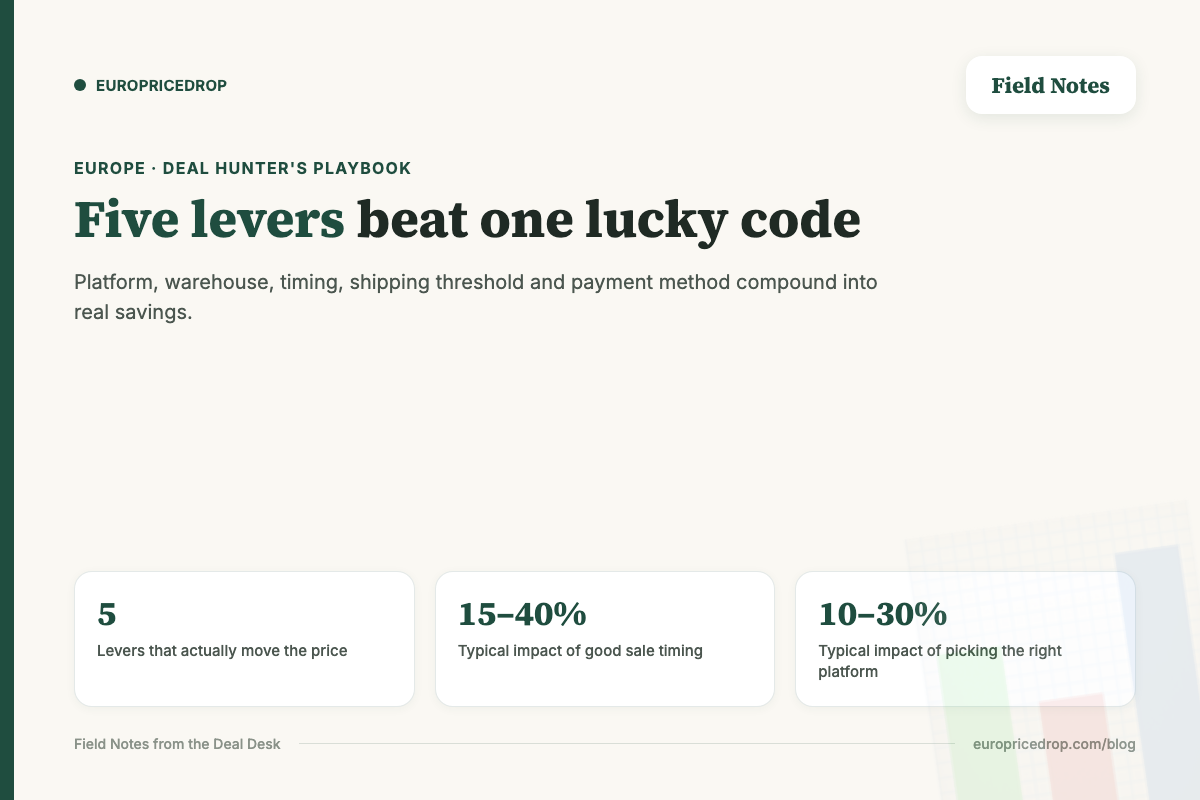
The five levers that move the price
The biggest savings come from stacking platform choice, warehouse origin, sale timing, free-shipping thresholds, and payment method — not from hunting a single better code. Each lever is worth a few percent alone; together they compound into a materially different final price.
| Lever | Typical impact | Effort required |
|---|---|---|
| Platform choice | 10–30% | Low — check two before buying |
| Warehouse origin | 5–15%, plus faster delivery | Low — check the listing badge |
| Sale timing | 15–40% | Medium — requires planning ahead |
| Free-shipping threshold | 5–10% (avoiding paid shipping) | Low — basket planning |
| Payment method match | 0–5%, but affects conversion success | Low — check before checkout |
None of these individually is dramatic. Stacked, they’re the difference between paying close to list price and paying meaningfully less for the same basket.
Lever one: pick the right platform for the category
This is the highest-leverage decision and the one most shoppers skip. Temu and AliExpress consistently price lowest for everyday basics and niche items respectively — Temu runs consistent sitewide pricing, while AliExpress’s independent-seller model means more variance but also more room to find a genuinely lower price if you compare a few listings. Amazon rarely wins on price but wins on speed and return simplicity, which matters when the item needs to arrive by a specific date. Shein leads fashion specifically, with no code to hunt for since discounts auto-apply.
The mistake we see most often: defaulting to one habitual platform regardless of category. A five-minute check across two platforms before checkout is the single easiest lever on this whole list.
Lever two: warehouse origin changes both price and speed
A listing shipping from a regional EU or UK warehouse — AliExpress’s “Choice” badge, most current Temu stock — typically lands in 7–14 days with VAT already included cleanly. The same item shipped direct from outside the EU can take 15–20 days and occasionally trigger a courier charge on delivery if VAT wasn’t handled upfront. This isn’t just a speed question — regional-warehouse listings are also less likely to cross the customs duty threshold that can add cost on larger orders. Our AliExpress warehouse shipping piece and Temu shipping times breakdown both cover this in more depth.
Want live deals across multiple platforms? We track pricing and thresholds for six platforms across every country.
See UK deals →Lever three: timing beats almost everything else
Sale timing is the highest-impact lever on this list, and the least used well. Most shoppers know about Black Friday. Fewer plan around the full calendar — France’s legally regulated soldes windows, Germany’s Black Week extending well past a single Friday, Spain’s regional summer sale dates, or the mid-year events (Prime Day, Temu’s 6.6, AliExpress’s mid-year sale) that fall outside the obvious November/December window. Buying a big-ticket item outside any of these windows, when a wait of a few weeks would have landed a real discount, is the single most common way shoppers leave money on the table.
Lever four: free-shipping thresholds are basket math, not luck
Free-shipping thresholds cluster around £20 in the UK and €25 across most of the Eurozone for platforms like Temu — low enough that hitting them deliberately, rather than accidentally falling short and paying for shipping, is usually just a matter of adding one more small item you’d have bought anyway. The math is simple: paying £3–5 shipping on a £15 order is a worse deal than adding a £5 item and clearing the threshold, even though the second basket costs more upfront.
Lever five: payment method match affects more than convenience
This one’s counterintuitive — using the payment method a checkout actually expects doesn’t just avoid friction, it occasionally unlocks method-specific promotions (some platforms run Klarna-specific or PayPal-specific offers in certain markets). More importantly, checkouts that don’t recognise your preferred method sometimes route through a less favourable currency conversion. Our how Europeans shop online piece covers which method dominates where — iDEAL in the Netherlands, SEPA and Klarna in Germany, Bizum in Spain.
The return-policy math nobody does
A “cheaper” purchase with a restrictive or costly return policy can end up more expensive than a slightly pricier one with free, simple returns — especially in fashion, the single most return-heavy category by volume. Before treating price as the only variable, check who pays for return shipping and how long the window actually is. The EU’s 14-day cooling-off right is a legal minimum, not a guarantee that the process is painless; platform-specific policy is what actually determines the real cost of getting it wrong.
Cross-border price-checking: worth it only sometimes
VAT rates alone range from 4.5% in Andorra and 8.1% in Switzerland up to 27% in Hungary — a genuinely wide spread across the markets we track. In theory, shopping from a lower-VAT market could save money. In practice, most major platforms price per your delivery address regardless of which country’s storefront you browse, so this rarely works the way people assume, and attempting to game it usually just adds shipping complexity for no real saving. The exception is genuine cross-border travel purchases — covered in our travel shopping guide — where tax-free refunds are a real, legitimate mechanism.
Spotting fake urgency and inflated “was” prices
Countdown timers, “only 3 left,” and a crossed-out “was” price next to today’s discount are common enough across online retail that they’re worth treating with routine scepticism rather than reacting to. Some are genuine — a real flash sale with a real end time. Plenty are cosmetic, resetting the moment you refresh the page or reflecting a “was” price that was never actually charged to anyone. The practical test: if a platform shows genuine price history (some do, most don’t), check it before trusting the crossed-out number. If it doesn’t, treat the discount claim as marketing rather than fact, and judge the price on its own merits against what you’d pay elsewhere — not against a number the retailer chose to display next to it.
This matters more on unfamiliar platforms and third-party marketplace sellers than on the handful of large platforms we track directly, where pricing tends to be more consistent day to day rather than manufactured around artificial scarcity.
Cashback and browser extensions: a smaller lever, still worth using
Cashback portals and browser price-comparison extensions sit lower on the impact list than the five core levers above, but they’re close to free to use once set up, which makes them worth layering on top rather than relying on alone. The realistic expectation: a few percent back on qualifying purchases, not a transformative saving, and payout timelines that can run weeks to months depending on the portal and platform. Treat this as a small bonus stacked on top of getting the platform, timing, and warehouse choice right — not a replacement for any of them. A cashback rate on an already-inflated price is still a worse deal than a genuinely competitive price with no cashback at all.
Building a personal price-check habit
The shoppers who consistently save the most aren’t doing anything exotic — they’ve built a habit of checking two sources before any purchase above a threshold they’ve set for themselves (often somewhere around £30–50), rather than treating every single purchase as worth the research time. Below that threshold, the time cost of comparison shopping usually exceeds the money saved. Above it, five minutes of checking routinely pays for itself. Setting that mental threshold explicitly — rather than either compulsively checking everything or checking nothing — is a genuinely underrated habit most of the advice in this space skips past in favour of individual tactics.
Putting it together: a five-minute pre-checkout routine
- Check two platforms, not one, for anything above a small purchase.
- Look for a regional-warehouse badge if delivery speed or customs exposure matters.
- Check whether a sale event is close — a few weeks’ wait can be worth a real discount.
- Round the basket up to the free-shipping threshold rather than paying for shipping on a smaller order.
- Confirm your payment method is supported before you’re mid-checkout, not after something fails.
None of these steps take long individually. Run through all five and the compounding effect is real — this is the actual difference between shoppers who save a little and shoppers who save a lot on comparable baskets.
FAQ
What’s the single most effective way to save money shopping online in Europe? Comparing at least two platforms before checkout — it’s the lowest-effort, highest-leverage habit on this list, and the one most shoppers skip entirely.
Does shopping from a different country’s storefront actually save money? Rarely — most major platforms price by delivery address, not by which country’s site you’re browsing from, so this doesn’t work the way people often assume.
Is it worth waiting for a sale event instead of buying now? For anything non-urgent and above a modest price point, usually yes — timing is one of the highest-impact levers, often worth more than any single promo code.
How much does warehouse origin actually matter for price? Meaningfully — regional-warehouse listings tend to avoid customs duty exposure on larger orders and include VAT more reliably upfront, on top of shipping faster.
We track live pricing, thresholds and warehouse routing across every platform and country — check our UK Temu page for what’s currently live.